Novelist
draws on her love for New Zealand and the theatre
Vintage Murder begins as Roderick Alleyn makes a train journey across New Zealand
Ngaio Marsh
transports her upper class, English sleuth, Roderick Alleyn, to her native New
Zealand in Vintage Murder, her fifth novel to feature the Scotland Yard
detective.
Alleyn is on
holiday while recovering from an operation and the story begins as he makes a
long journey by train across New Zealand. On the train, he encounters a
travelling theatrical troupe and among them is Susan Max, a character actress he
had met in Enter a Murderer, Ngaio’s second novel. The detective had encountered
the actress while he was investigating a murder that occurred on stage during the
performance of a play at a West End theatre.
He gets talking
to different members of the troupe, which is run by Incorporated Playhouses,
and it is not far into the story when Alfred Meyer, the owner of Incorporated
Playhouses, who is married to the leading lady, Carolyn Dacres, reveals to Alleyn
that someone has tried to push him off the train.
After the
train has arrived at its destination, Carolyn invites Alleyn to see the first
night of the play and to her birthday celebrations with the rest of the company
on the stage afterwards. At the party, as a surprise for his wife, Meyer has
arranged for a jeroboam of champagne to descend gently on to the dinner table from
above, but something goes horribly wrong and the theatrical manager is killed.
The latest HarperCollins edition of Ngaio Marsh's Vintage Murder
It soon
becomes obvious that the mechanism set up for the stunt has been tampered with
and Alleyn is invited by the local police to sit in on their investigation. He sets
aside his holiday plans to try to help them catch the murderer.
Vintage
Murder, which was published in 1937, enables Ngaio Marsh to describe the
scenery of her homeland as seen through Alleyn’s eyes. He meets a Māori doctor,
Rangi Te Pokiha, and buys a Māori fertility pendant, a ‘tiki’, which plays an
important part in the plot.
Vintage
Murder was one of four Alleyn novels adapted for New Zealand television in
1977, when the role of Alleyn was played by the actor George Baker.
Ngaio’s
inspiration for the travelling theatrical troupe was the Alan Wilkie Company,
which she was once a part of, so it is not surprising that the characters and
their behaviour come across as so real in the story.
The story
does consist of a long series of interviews conducted by Alleyn along with the
New Zealand police officers, which many on line reviewers have complained about,
but I still think it is a well written novel that presents a good mystery for
the armchair detective to try to solve, and I would recommend it.
Academic created a series detective who went on to have a 50-year career
The cover of the Agora Books edition of the first Appleby novel
Michael Innes, who has entertained millions of crime fiction fans with his novels and short stories featuring Scotland Yard Detective Inspector John Appleby, was also a distinguished academic who was well known for his works of literary criticism.
Innes, who was born in 1906 in Edinburgh, 116 years ago today, was, in fact, John Innes Mackintosh Stewart, who became a university professor and published more than 20 contemporary novels and volumes of short stories under his real name.
Between 1936 and 1986, Stewart, writing under the pseudonym, Michael Innes, also published nearly 50 crime novels and short stories.
The author had attended Edinburgh Academy and went on to study English Literature at Oriel College, Oxford. He went to Vienna to study psychoanalysis and on his return became a lecturer in English at the University of Leeds.
He became Jury Professor in English at the University of Adelaide in South Australia and then a lecturer in English at the Queen’s University of Belfast.
In 1949, he became a Student of Christ Church, Oxford, a position that was the equivalent of being a Fellow at other Oxford colleges. He was a professor of the university by the time of his retirement from academia in 1973.
Innes was able to use his knowledge of university life as the setting for his first Appleby novel, Death at the President’s Lodging, which features a murder at a fictitious college belonging to a fictitious university.
The reader first sees Appleby being driven out of Scotland Yard in ‘a great yellow Bentley’ to the crime scene in the President’s Lodging at St Anthony’s College, which purports to be at a university situated in the vicinity of Bletchley, about halfway between Oxford and Cambridge. A useful line-drawing of a map showing the layout of St Anthony’s had been provided for the reader at the beginning of the book.
John Innes Mackintosh Stewart - alias Michael Innes - pictured in 1973
In the first paragraph on the first page, Innes announces that the President of St Anthony’s College, Josiah Umpleby, has been found murdered in his lodging. Appleby has been quickly dispatched on the orders of the Home Secretary to take over from the local Inspector and handle the investigation.
Inspector Dodd, who is an old friend of Appleby’s, explains that the college is locked up at the same time every night and only a small, select group have their own keys and would have been able to access the President’s Lodging. He shows Appleby the dead body, still lying in the President’s library, with its head swathed in a black, academic gown, next to a skull and a scattering of human bones.
By the end of the first chapter, Appleby has realised he is up against an ingenious and somewhat whimsical murderer. The scene has been set and the hunt is on, with the reader able to sit back and enjoy the rest of the novel.
The story is told in an entertaining writing style and Innes allows his own interest in the genre of detective stories to shine through in conversations Appleby has with the dons while staying in their college as a guest.
Death at the President's Lodging is available from or
Not so much
a whodunit, more a question of who is trying to do it
Danger Point was first published in 1941
The self-effacing,
elderly lady detective, Maud Silver, is sitting on a train about to depart to
London when a young woman who is clearly very upset bursts into her
compartment.
The woman is
a wealthy heiress, Lisle Jerningham, who has recently got married and should
have been blissfully happy. But she has overheard a sinister conversation in
the garden of a country house, which has terrified her.
Lisle
confides in Miss Silver about fleeing from the house party she had been
attending after hearing total strangers discussing how her husband’s first wife
died in an apparent accident. After Lisle’s new husband inherited his first
wife’s considerable fortune, he was able to save his family home. The unknown people
seemed to think her husband was broke again and were speculating about whether
he would attempt to engineer a second convenient misadventure.
Miss Silver
does her best to calm Lisle down and gives the distraught young woman her
business card in case she wants to consult her professionally at any time.
But the
beautiful heiress has mixed emotions once she has started to feel better. She
loves her new husband, Dale Jerningham, and can’t allow herself to believe that
he would wish to harm her, even though she has started to wonder about a recent
incident when she nearly drowned while swimming with him and other members of
his family.
Miss Silver
does not know whether Lisle really is in danger or is simply being paranoid.
But after another attempt is made on Lisle’s life, the young wife gets in touch
with her at her London office and then subsequently cancels the appointment she
has made. After reading in the newspaper that another young woman has been
found dead near Lisle’s coastal home, the detective decides to travel there in
order to investigate further.
Danger Point
is Patricia Wentworth’s fourth Miss Silver novel and was first published in
1941. Like her previous Miss Silver story, Lonesome Road, it involves a rich young woman who someone is
trying to kill. But is it Lisle’s handsome husband, another member of his
family, or a disgruntled former employee?
Patricia Wentworth could draw on a depth of life experiences
Patricia
Wentworth was the pen name of Dora Amy Elles, who was born in India, where her
father was stationed with the British Army, in 1877. She was sent to England to
be educated, but returned to India and married George Dillon in 1906. He had
three children from a previous marriage and they had one child together. After
his death she moved back to England with the children.
In 1920 she
married again, to George Turnbull, and settled in Surrey. She had begun writing
while in India and in 1910 had won the Melrose Prize for her first published
novel, A Marriage Under the Terror, which was set during the French Revolution.
Under the
pen name of Patricia Wentworth, she wrote 32 crime novels featuring Miss
Silver, beginning with Grey Mask in 1928 and ending with Girl in the Cellar in
1961, the year of her death. Miss Silver develops as a character during the
series and works closely with Scotland Yard. The reader eventually discovers
she is a retired governess with a passion for Tennyson as well as for knitting.
I would
recommend Danger Point, which is very well written with good descriptions of
the coastal scenery that form the backdrop for the story. Patricia maintains the
mystery and the suspense right until the end. It is less a question of whodunit
and more a matter of the reader finding out who is trying to do it.
Author was a
bank clerk by day and a novelist by night
A new edition of Murder in Blue was published in 2021
Clifford
Witting, who was born on this day in 1907, 115 years ago today, in Lewisham in
Kent, was one of the younger of the
Golden Age mystery writers. He worked as a clerk for Lloyds Bank during the day
and wrote 16 detective novels in the evenings, between 1937 and 1964.
His first
novel, Murder in Blue, was republished in 2021 by Galileo Publishers, making it
available again for present day fans of vintage detective stories to read and
enjoy. The novel was written while Witting was commuting to London for his day
job and he would work on it every night, despite the distractions of becoming a
young father.
Witting set
a lot of his mysteries in the small town of Paulsfield in the county of
Downshire behind the South Downs, which was based on the town of Petersfield in
Hampshire. He included many details about Petersfield as it was in the 1930s,
even describing the statue of King William III mounted on a horse that stands
in the market place, although in the fictional town of his novel, he says it is
the statue of a local lord.
He had a
flair for describing settings and wrote in a witty style. He also experimented with
the conventions of the detective story, showing his fascination with the genre.
His protagonist
in Murder in Blue, John Rutherford, runs a bookshop that stocks detective
fiction. He employs a young assistant, George, who is fascinated with whodunits
and is thrilled when his employer becomes involved in a real-life murder case.
Rutherford
is out walking one evening when he discovers the body of a young police officer
lying in a lane on the outskirts of the town. The police officer appears to have
been bludgeoned to death. Rutherford tries to think quickly and uses what he believes
to be the police officer’s bicycle to cycle to the police station and report
the tragedy.
Clifford Witting worked as a bank clerk by day
He is later taken
back to the scene of the crime by the investigating officer, Inspector
Charlton, so that he can point out the tracks he himself has left in the sodden
ground and help the Inspector identify any clues that have been left by the
murderer. He is also called to give evidence at the inquest and soon becomes on
friendly terms with the detective.
The story is
given additional interest by the complication that Rutherford has recently
fallen in love with a beautiful young woman after their cars collided in the
fog. A love interest in a detective story was frowned on in those days by other
Golden Age writers, but in Murder in Blue it is an additional source of
suspense for the reader. I found myself wondering how the relationship would turn
out and whether it would have anything to do with the murder.
Witting’s
two series characters, Sergeant - later Inspector - Peter Bradford and Inspector
Harry Charlton, appear in most of his 16 books.
During World
War II, Witting served as a bombardier in the Royal Artillery and a Warrant
Officer in the Royal Army Ordnance Corps. He joined the Detection Club in 1958,
11 years after the original publication of Murder in Blue, at a time when
Agatha Christie was the president. Witting died in 1968 in Surrey.
Newspaper
critics of the time gave his books good reviews, saying he produced interesting
puzzles with ingenious solutions and that he played fair with the reader. I
would definitely recommend Murder in Blue, as I think it is a good read and keeps
up the whodunit element well. The novel also provides an interesting snapshot
of life at the time it was set.
The novel that
introduces the likeable but fallible Inspector Alan Grant
The Arrow edition of The Man in the Queue
A man is
found with a stiletto in his back, having been stabbed to death while queueing
for the last night of a popular West End show. The main problems for Inspector
Alan Grant of Scotland Yard, who is deployed to investigate the killing, are the
lack of clues to the victim’s identity and the fact that no one in the queue seems
to have seen what happened.
The Man in
the Queue, the first detective novel by Josephine Tey, was published in 1929,
just eight years after Agatha Christie’s first novel, The Mysterious Affair at
Styles, and six years after Dorothy L Sayers published her first novel, Whose Body?
But unlike
Poirot and Wimsey, Alan Grant is a detective by profession and not an amateur
sleuth. The novel is an early version of a police procedural and shows Grant
interacting with his superiors and subordinates and making use of the forensic
tools the police had at their disposal in the 1920s to try to solve the case.
Josephine Tey
was a pseudonym used by the writer Elizabeth MacIntosh, who was born in 1896 in
Scotland. She trained as a Physical Training instructor and taught at schools
in Scotland and England. In 1923 she returned to her family home in Inverness to care for
her invalid mother and keep house for her father and it was then that she began
writing.
The Man in
the Queue was her first mystery novel and introduced her series detective,
Inspector Alan Grant. It was awarded the Dutton Mystery Prize after it was
published in America.
MacIntosh’s main
ambition was to write a play that would have a run in the West End and her
drama, Richard of Bordeaux, was such a success when it was first staged in 1932
that it was transferred to the New Theatre, now the Noel Coward Theatre, where
it had a year-long run and made a household name of its young leading man, John
Gielgud.
Josephine Tey was a pseudonym used by Elizabeth MacIntosh
As Josephine
Tey, MacIntosh produced six novels featuring Alan Grant. The fifth novel, The Daughter
of Time, published in 1951, was voted the greatest crime novel of all time by
the British Crime Writers Association in 1990.
There is a
lot to like about The Man in the Queue. There are beautiful descriptions of Tey’s
native Inverness, where she sends Grant in pursuit of a suspect. All the
characters, police and suspects alike, are interesting and believable. Grant is
a well-rounded policeman, not just a caricature, who is looked after by his
landlady, dines regularly at a French restaurant, and is popular with the
ladies, making me keen to read the next book in the series, A Shilling for Candles.
Perhaps the
most strikingthing about the novel is
the clever plot. Like other writers of the period, Tey is not afraid to show
Grant arresting the wrong man and feeling dissatisfied with his solution. She
also manages to keep the true identity of the murderer a secret right up to the
end.
The Man in
the Queue was republished by Arrow Books in 2011.
Remembering an early writer of the police procedural
The British Library Crime Classics edition
Bats in the Belfry, the 13th novel in the series featuring Chief Inspector MacDonald of Scotland Yard by E C R Lorac, has a complex plot with the focus on the way detectives in the 1930s used standard police procedure to solve cases.
First published in 1937, the novel may seem rather dated in 2022, but it is fast moving and presents a challenging puzzle for the reader. It was reissued in 2018 by the British Library in their Crime Classics series and is now also available in large print.
Bats in the Belfry is the story of a failed novelist and his wife, a successful actress, who lead separate lives in their smart house in London. When the husband is called away suddenly to Paris, he seems to disappear completely. His suitcase and passport are later found in a sinister artist’s studio, the Belfry, in a dilapidated house in Notting Hill.
The novelist’s friends set out to investigate what has happened to him but find things at the Belfry are so sinister they decide to enlist the help of the police and Chief Inspector Macdonald, already an established series character, takes over the case.
By the time
Lorac wrote Bats in the Belfry, she was an experienced writer of whodunnits and
had developed the skill of being able to shift suspicion from one character to
another while keeping up the interest for the reader.
The opening
scene introduces most of the characters who will play a central part in the
story. They have gathered together following a funeral and before long the
conversation turns to the subject of how to dispose of a body. This conversation
contains a vital clue for those alert enough to spot and remember it…
E C R Lorac was the pen name of Edith Caroline Rivett, who died 64 years ago today. She wrote under the pseudonyms E C R Lorac, Carol Carnac and Mary Le Bourne during the Golden Age of Detective fiction.
Lorac
chose her pseudonym because it was the name Carol, which was part of her name,
spelt backwards. Her first detective novel, Murder on the Burrows, which
introduced Chief Inspector Macdonald, was published in 1931 when she was 37. She wrote 48 mysteries as E C R Lorac and 23 as Carol Carnac along with other novels, short stories and radio and stage plays, before her death in 1958.
Campion meets a flame-haired beauty who is a most unconventional heroine
A Vintage Books edition of Sweet Danger
There is the first sign of a love interest for the mysterious Albert Campion in Sweet Danger, the fifth novel written by Margery Allingham about her hero’s adventures.
Campion meets the plucky Amanda Fitton, a beautiful teenage girl, who works with him to thwart a deadly enemy intent on defrauding her family of its inheritance. The novel is full of action, danger and eccentric characters and ends with the most delicate of hints that there might be romance in the future for the noble adventurer, Campion.
Sweet Danger was first published in 1933 in the UK. However, it is not a typical novel of its time. Amanda Fitton is not a damsel in distress for Campion to rescue. She is a hard-up and not very well dressed 17-year-old, who is interested in experimenting with radio signals and electricity.
Campion has been tasked by the British Government with finding proof of ownership of Averna, a small, oil rich principality on the Adriatic, which has become a vital port after an earthquake has given it a natural harbour. He goes to the village of Pontisbright in the depths of the Sussex countryside, where he meets Amanda and her family who, as rightful heirs to the principality, insist on joining Campion’s quest.
Although Campion and his friends agree to join forces with the Fitton family, whose ancestors were given the principality way back in history, an unscrupulous financier and his hired thugs are also on the trail. The family suffer violent attacks and Campion’s friends are tied up in sacks and shot at, while Campion himself goes missing.
During a showdown with the main villain, Amanda saves Campion’s life, but she has been shot herself in the process. Thankfully, her wound is not life threatening and in the last pages of the book she asks him to take her into partnership in his business ‘later on’…
Allingham's writing was notable for her insight into character
In 2022, Sweet Danger might seem like a far-fetched story to modern crime fiction fans, but I think it is well written and a gripping page-turner and still worth reading.
Margery Allingham, who died on this day in 1966, was a prolific writer during the Golden Age of Detective Fiction. She left a legacy of 18 Albert Campion mysteries, six volumes of short stories about the detective and many stand-alone novels, novellas and volumes of short stories.
Margery died of cancer in hospital in Colchester six weeks after her 62nd birthday. She was in the process of writing her last novel, Cargo of Eagles, and had mapped out the story long before her death. Her husband, Philip Youngman Carter, was able to finish it, as she herself would have done, following her plan.
In a preface to Mr Campion’s Clowns, an omnibus of novels by Margery Allingham, published in 1967, Youngman Carter paid tribute to his late wife as ‘a generous, kind and courageous woman with a rare gift for friendship’.
Margery showed wonderful insight into character and her books abound in witty and accurate observations of people. As she matured as a writer, her books became deeper and started to encompass significant themes, such as love and justice, good and evil, and illusion and truth. Her works have now attained classic status and she has, at times been compared with Charles Dickens and Robert Louis Stevenson
Vintage Books, part of the Penguin Random House Group, have now republished all Margery’s novels featuring her series detective Albert Campion.
A detective
novelist who brilliantly describes backstage life
Ngaio Marsh, who
was one of the leading female detective novelists of her time, died on this day
– 18 February – in 1982 in her native New Zealand.
Ngaio began
writing detective novels in 1931 after moving to London to start up an interior
decorating business. Stuck in her
basement flat on a very wet Saturday afternoon she decided to have a go at
writing a detective story and came up with the idea for her sleuth, Roderick Alleyn, a gentleman detective.
Ngaio Marsh came to be seen as one of the Queens of Crime
She sat down
to write what was to be the first of a series of 32 crime novels featuring Alleyn,
who she named after an Elizabethan actor, Edward Alleyn. Her detective was to work
for the Metropolitan Police in London, even though he is the younger brother of
a baronet.
Her second
novel, Enter a Murderer, published in 1935, and several others, are set in the
world of the theatre, which Ngaio knew well as she was also an actress,
director and playwright at times during her life.
After leaving
school she had studied painting before joining a touring theatre company. She
became a member of an art association in New Zealand and continued to exhibit
her paintings with them from the 1920s onwards.
Ngaio allows her
detective, Alleyn, to meet and fall in love with an artist, Agatha Troy, in her 1938 novel, Artists in Crime.
She directed
many productions of Shakespeare’s plays in New Zealand and Australia and the
430-seat Ngaio Marsh Theatre at the University of Canterbury in New Zealand is
named in her honour.
In her 1946
short story, I Can Find My Way Out, which features Alleyn, Ngaio once again
uses the theatre as her setting. A new playwright, Anthony Gill, is waiting
nervously for the premiere of his first play at The Jupiter Theatre in London.
The female
lead, Coralie Bourne, has been kind to him and advised him on his play, but the
male lead, Canning Cumberland, is known to have a drinking problem and can be
unpredictable, which worries Gill. Two of the other actors also resent Cumberland,
one because he was given the best part and the other because he was given the
best dressing room.
Meanwhile,
Roderick Alleyn and his now wife Troy are entertaining a friend, Lord Michael
Lamprey, for dinner. He is keen to join the police but his conversation with Alleyn
is constantly interrupted by phone calls that are actually meant for a delivery
firm. When one of the callers asks if they can deliver a suitcase to playwright Anthony Gill at the Jupiter Theatre, Lord Michael thinks it would be fun to
take the job as he has been unable to get a ticket to see the play.
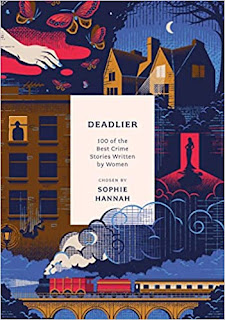
Sophie Hannah's collection of stories is published by Apollo
Before he
reaches the theatre, the case falls open and he discovers a false ginger beard
and moustache, a black hat, a black overcoat with a fur collar and a pair of
black gloves.
On an impulse
Lord Michael puts the whole outfit on and insists on being allowed to deliver
the case in person to the playwright backstage.
As Coralie makes
one of her exits from the stage, she sees him standing in the wings wearing the
beard and black clothes and faints. The male lead, Cumberland, also reacts with
horror when he sees him and locks himself in his dressing room.
Lord Michael
continues to watch the play from the wings with fascination, although he becomes
increasingly aware of the smell of gas. Eventually, he traces the smell to one
of the dressing rooms, gains access and drags out the unconscious occupant, but
sadly it is too late to save him.
He rings
Alleyn and the detective arrives at the theatre with his men, where it does not
take him long to discover that one of the actors has been murdered.
In just 18
pages, Ngaio sets up the story, establishes the characters and their
relationships, brilliantly describes the dressing rooms, equipment and
atmosphere backstage, drawing on her experience of the theatre, and allows
Alleyn to solve the crime.
Along with
her fellow Queens of Crime, Margery Allingham, Agatha Christie and Dorothy L
Sayers, Ngaio was to dominate the genre of crime fiction from the 1930s onwards
with her novels, short stories and plays.
In 1948 Ngaio
was appointed an Officer of the Order of the British Empire for services in
connection with drama and literature in New Zealand. She became a Dame
Commander of the Order of the British Empire for services to the arts in the
1966 Queen’s Birthday Honours.
Ngaio’s autobiography,
Black Beech and Honeydew was published in 1965. She was inducted into the
Detection Club in 1974 and received the Grand Master Award for lifetime
achievement as a detective novelist from the Mystery Writers of America.
Her 32nd and
final Alleyn novel, Light Thickens, was completed only a few weeks before her
death. The story revolves around one of her greatest theatrical passions,
Shakespeare’s play, Macbeth.
Ngaio died in
her home town of Christchurch and was buried at the Church of the Holy
Innocents, Mount Peel.
The Ngaio
Marsh Award is given annually to the writer of the best New Zealand mystery,
crime or thriller novel. Her home in Christchurch is now a museum and displays her
collection of antiques. On her desk lies her fountain pen filled with green ink,
which was her preferred writing tool.
Ngaio Marsh’s
32 Roderick Alleyn crime novels and her collections of short stories are available in a variety of
formats from or
Sleepy
village provides interesting material for Freud follower Mrs Bradley
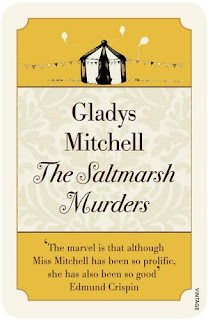
The Saltmarsh Murders was the fourth Mrs Bradley mystery
The Vicar’s
maid is strangled only a few days after giving birth to an illegitimate baby that
no one has ever seen in The Saltmarsh Murders, the fourth novel to feature the
psychoanalyst and amateur detective Mrs Beatrice Adela Lestrange Bradley.
Conveniently,
Mrs Bradley is staying at the Manor House in the village of Saltmarsh, as a
guest of the local squire and she is only too happy to lend a hand with the murder
inquiry.
As a professional
psychiatrist and follower of Freud, Mrs Bradley finds a wealth of interesting
cases in the village to test her theories on. She encounters a female resident who
believes everyone in the village is some kind of animal and meets the bizarre
inhabitants of a remote bungalow who have imprisoned their neighbour in the
crypt of the church.
The story
is told from the point of view of the young curate, Noel Wells, who lives at the vicarage and is in love with
Daphne, the Vicar’s niece.
Mrs Bradley
adopts Noel as her ‘Watson’, asking him to introduce her to some of the families
in the village and also to provide her with secretarial assistance.
Noel is
both terrified and fascinated by Mrs Bradley. He admires her brains and beautiful
voice, but he hates being prodded in the ribs by her yellowed talons and is
unnerved by her sinister cackle. Seeing Mrs Bradley through his eyes, when he
does not completely understand her theories or why she is behaving the way she
does, is amusing and also a clever device by Gladys Mitchell to keep the
mystery going until the end of the book.
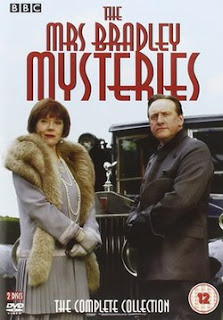
Some of the Mrs Bradley novels were adapted as a BBC TV series
Mrs Bradley’s
investigation uncovers a smuggling racket and involves a corpse going missing, the
vicar being locked upin the village pound
and an exhumation being ordered, before peace can be restored to the sleepy
village of Saltmarsh.
The book reveals
a lot of interesting detail about life in England at the beginning of the
1930s. As a schoolteacher, Gladys is able to portray children and young people
very well and, as in her first three books, she uses them as main characters.
Gladys wrote 66 novels featuring her amateur
sleuth, Mrs Bradley, as well as mystery novels under the pen name Malcolm
Torrie, and historical adventure novels under the pen name Stephen Hockaby.
She got off the mark in 1929 with Speedy Death, which
introduced Mrs Bradley, and she never looked back, writing at least one novel a
year throughout her career and gradually building a large and loyal following
for her eccentric but brilliant detective.
Gladys was an early member of The Detection Club
along with Agatha Christie, G K Chesterton and Dorothy L Sayers, but frequently
satirised or reversed the traditional patterns of the genre in her novels.
In 1961, Gladys retired from teaching but continued
to write. She received the Crime Writers’ Association Silver Dagger in 1976.
The last Mrs Bradley mystery was published in 1984,
the year after the author’s death in Corfe Mullen, a village in Dorset.
The Saltmarsh Murders by Gladys Mitchell was first
published in 1932 but has been republished by Vintage Books and is now available
as a paperback or Kindle edition.
An unusual
setting for a 1936 detective novel with a closed circle of suspects
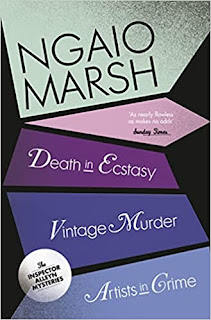
Death in Ecstasy is available as part of a Ngaio Marsh collection
When bored journalist
Nigel Bathgate attends a meeting of a dubious spiritual cult just out of curiosity,
he gets more entertainment than he bargained for. As he watches a group of
people at the altar pass round a silver flagonof wine, he sees one of them drink from a jewelled cup and then immediately
fall dead to the floor.
At first the
other initiates think the young female victim is experiencing ecstasy, but then
one of them notices her clenched teeth and ‘lips drawn back in a rigid circle’
and makes the others aware that she is dead. Nigel keeps his nerve amid the
panic and asks to use the telephone to ring his close friend, Detective Chief Inspector Roderick Alleyn of
Scotland Yard.
Alleyn and
Bathgate soon discover that the victim, Cara Quayne, a beautiful and wealthy young
woman, was a deeply religious initiate who had been training for a month for the
bizarre ceremony of becoming the Chosen Vessel at the House of the Sacred Flame.
Nigel’s
suspicions had been aroused by the distinctive smell coming from the victim,
who had died immediately after drinking the ritual wine. He and Alleyn quickly discover
that the wine had been poisoned with cyanide.
As Bathgate
was present when the death occurred, Alleyn allows the journalist full access to
the investigation, allowing him to take notes while he questions the witnesses.
He also encourages Bathgate, who in many of the novels serves as Alleyn’s ‘Watson’,
to befrienda young couple who were
present at the altar when the murder took place.This would of course not happen in real life,
or modern detective novels, but I think the author can get away with itbecause the story was written more than 80
years ago.
The actor Geoffrey Keen played Marsh's detective Roderick Alleyn in TV adaptation
Alleyn takes
the names of all the people who were with Cara at the altar. They are all
suspects because any of them could have added the cyanide to the wine as they
passed the flagon round. And at the top of the list is Father Jasper Garnette,
the officiating priest.
This fourth
Detective Chief Inspector Alleyn mystery by Ngaio Marsh, published in 1936, is
a departure from the country house mystery that was so fashionable at the time.
But it has a limited circle of suspects, as they are all middle-class people living
in flats and houses in an upmarket area of London, who pay calls on each other
and dine with each other.
Alleyn and Bathgate
uncover the usual motives for murder, such as lust, jealousy, greed for money
and unrequited love. They come across a significant clue when they find a book
hidden in Father Garnette’s bookcase that falls open at a page with a recipe
for home made cyanide. Ngaio is very clever with this clue, which keeps the
identity of the murderer hidden until the end, and she provides enough twists
along the way to distract the reader.
I would
recommend Death in Ecstasy because it is a well written, satisfying puzzle that
reveals more about the character of Ngaio’s series detective, Roderick Alleyn.
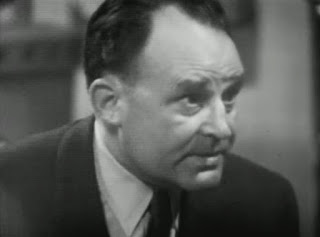
Death in Ecstasy was adapted for television in 1964 with Geoffrey Keen in the Alleyn role, Keith Barron as Bathgate, Joss Ackland as Jasper Garnette and Nigel Hawthorne as a temple doorkeeper.
One of three novels featured in Book Two of a Ngaio Marsh Collection published by Harper Collins, it is available from or
Campion
uses his detection skills and solves the mystery before the cops
The cover of the newest available edition
Mr Albert Campion
is asked by Joyce, the fiancée of one of his friends, to trace a distant
relative she calls Uncle Andrew, who has gone missing from the house in Cambridge
where they both live.
But before Campion
and Joyce have even left London for Cambridge, they find out that the body of
Uncle Andrew has been found in a river. He had been bound hand and foot with
cord and shot in the head.
In this
fourth novel to feature the mysterious Mr Campion, the author, Margery Allingham, allows
hints to be dropped by one of the characters that Campion is from a prominent
British aristocratic family, giving the reader a tantalising clue about who he really is.
Campion
takes Joyce back to Socrates Close, the large old house where she lives with her
Great Aunt, Caroline Faraday, the widow of a famous Cambridge academic, and the other members of the strange and dysfunctional family, who she helps Mrs
Faraday to take care of.
Then Campion
goes to see his old friend Marcus Featherstone, who is a solicitor and Joyce’s
fiancé, to get some background about the case. When Marcus asks for his
professional assistance, Campion says: ‘I must warn you. I’m no detective, but
of course I’m open to help. What d’you think I can do for you exactly?’ This is
interesting because although we see him go on to use his skills to solve the
murder, he clearly does not see himself as a detective.
From the
previous novels, we know that Campion is well-educated, with quiet authority
and that he is not afraid to put himself in danger to help others. He lives
above a police station in London with an eccentric manservant and is reputed to
be a good man to call upon in a crisis. He appears to be more of a gentleman
adventurer than a private detective.
Nevertheless,
he goes to Socrates Close to meet the formidable Caroline Faraday, who, because
she thinks she knows his family, invites him to stay.
He uses his
skill and experience to work out what is going on at Socrates Close when a second member
of the family dies and another one is injured while they are both still inside the
house.
Peter Davison played Campion in a BBC TV adaptation of Margery Allingham's novels
Campion follows
up the clues he finds, such as the mysterious symbol drawn on the outside of one of
the library windows and a huge footprint found in the flower bed below.
Although he
works alongside his policeman friend, Stanislaus Oates, a senior Scotland Yard
detective, it is Campion who works out what has been happening in the house and
exposes the person responsible.
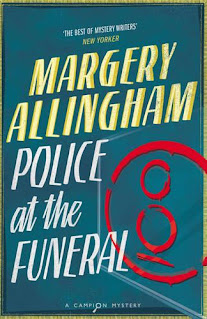
Police at
the Funeral, the fourth Campion novel, was published in Britain in 1931 and is the first
of the series not to have organised crime as a plot element. Instead, it is about
a wealthy family living together in a big house who are constantly having petty
squabbles. It is the first real detective story by Margery and is considered by
many of her readers to be one of her best novels.
She was later judged to be
one of the four Queens of Crime, along with her contemporaries, Agatha Christie, Dorothy L Sayers
and Ngaio Marsh, who were also writing during the Golden Age of detective
fiction.
A well-plotted novel that offers a glimpse of life after the First World War
The Unpleasantness at the Bellona Club is the fourth Wimsey novel
The fourth Lord Peter Wimsey novel by Dorothy L Sayers, The Unpleasantness at the Bellona Club, begins with Wimsey chatting with an acquaintance, Captain George Fentiman, in the bar of the Bellona Club on the evening of Armistice Day.
They joke about the club being like a morgue or funeral parlour, recalling a cartoon in the humorous magazine, Punch, in which an elderly member of a gentleman’s club summons a waiter to remove a fellow member from his chair on the grounds that he had been “dead for two days”.
Fentiman points out that his grandfather, General Fentiman, comes in every morning at 10 am, collects the Morning Post, settles into the armchair by the fire and becomes part of the furniture until the evening.
When Wimsey’s dinner companion, Colonel Marchbanks, arrives he goes to speak to General Fentiman who is still in his chair by the fire. He comes back to Wimsey and tells him something ‘rather unpleasant’ has happened.
It transpires that while they have been joking at the bar, old General Fentiman really was dead in his chair. A doctor is called and says rigor mortis is already well established.
Most of the action in the novel, first published in London in 1928, takes place in the fictional club for war veterans that Sayers has invented.
Doctor Penberthy, General Fentiman’s personal physician, certifies death by natural causes but is unable to give the exact time of his passing. This turns out to be rather crucial. As it happens, his wealthy sister had died on the morning of Armistice Day. If she had passed away first, the General would have inherited her fortune, which would then be left to his grandsons, Captain George and Major Robert Fentiman, who could both do with the money.
The brothers ask Wimsey to investigate, because unless they can prove that the General died after his sister, the entire fortune would go to her young, female companion.
Sayers was short of money until her novels took off
The novel paints an interesting picture of life in Britain after the First World War. Captain George Fentiman is still suffering from post-traumatic stress and his physical injuries have left him unable to work. He is dependent on his wife keeping them both on her earnings from a low-paid job and they are having to live in uncomfortable lodgings.
He is bitter that all he has been given by his country is the privilege of marching past the Cenotaph on Armistice Day, and yet serving in the war has cost him his job, his income and his good health.
Sayers herself knew what it was like to live on a low income in London between the wars and did not become prosperous until her Lord Peter Wimsey novels became a success.
There was a time when she was so hard up and short of money for food she considered taking a job as a teacher. Finally, in her 30th year, she sold the detective novel she had been working on in her spare time, Whose Body? which introduces Lord Peter Wimsey.
Sayers herself said of her creation of Wimsey: ’At the time I was particularly hard up and it gave me pleasure to spend his fortune for him. When I was dissatisfied with my single unfurnished room, I took a luxurious flat for him in Piccadilly… I can heartily recommend this inexpensive way of furnishing to all who are discontented with their incomes.’
Once Wimsey has started his investigation on behalf of the brothers, he finds establishing the time of the General’s death difficult. Unusually, no one saw the old man arrive at the Club on the morning of Armistice Day and can swear to him having been alive at that point. Eventually, Wimsey has to have the body exhumed and re-examined.
After discovering that the General had been poisoned, Wimsey tracks down the murderer, who then shoots himself in the Bellona Club library.
More unpleasantness for the members of the club to complain about!
This fourth Lord Peter Wimsey novel from Dorothy L Sayers, who was, in her day, judged to be one of the Queens of Crime, is definitely worth reading.